
 Generate

 Generate
 Adobe PDF
 Microsoft Word
 OpenDocument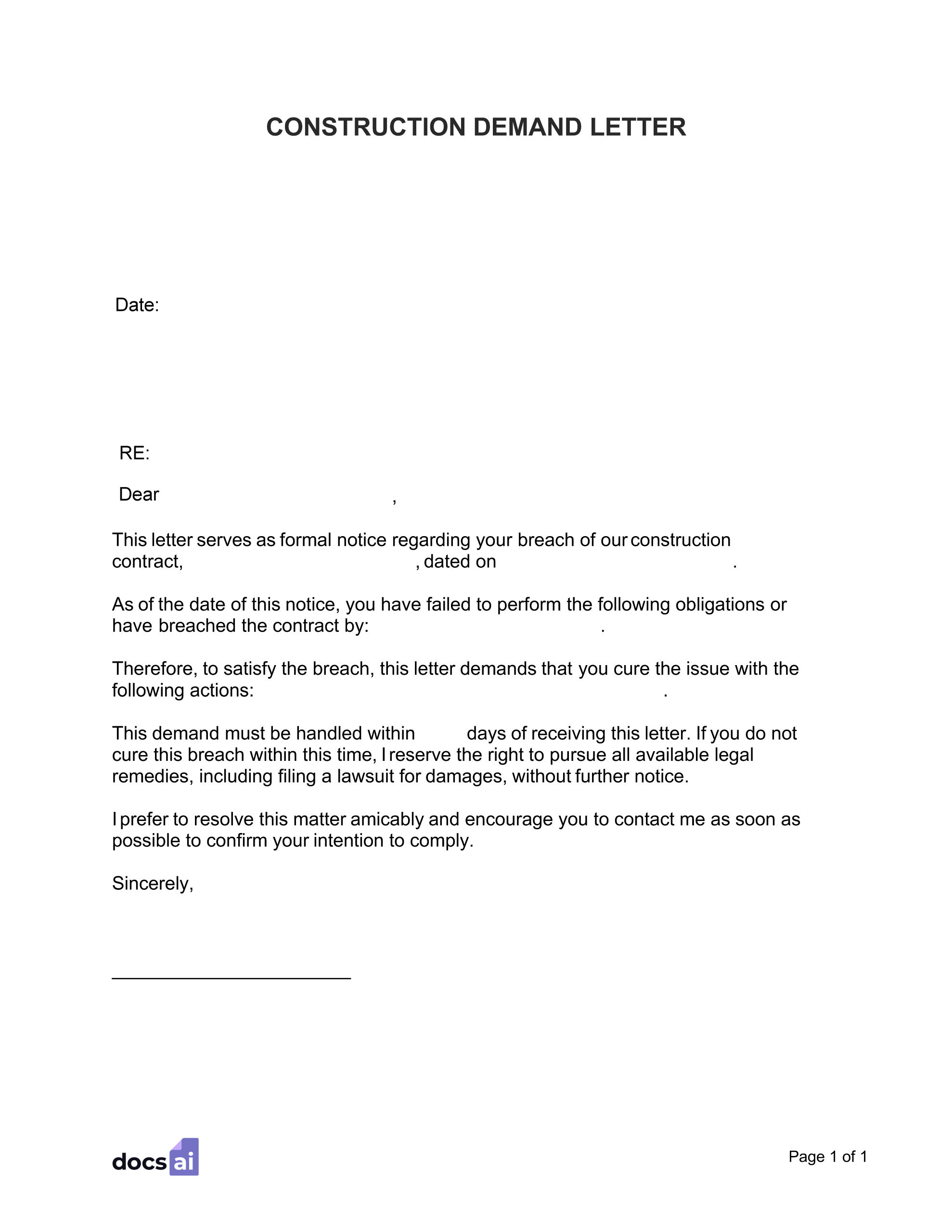
Key Features
- Legal Proof of Payment Request: Acts as proof to courts and arbitrators that attempts to seek payment or remedy were made in good faith.
- Supports Mechanic’s Lien Rights: Shows compliance with the steps needed to obtain this lien and thus serves to preserve mechanic’s lien rights.
- Resolves Disputes Without Litigation: Demonstrates that your company respects its contractual obligations and must be taken seriously.
- Sets a Resolution Timeline: Names an exact date or cure period for a remedy or payment to be delivered.
- States the Problem: Leaves no room for misinterpretation, therefore giving the offending party reasons to clarify or remedy the issue.
How to Remedy (5 steps)
1. Negotiate the Breach or Nonpayment
2. Formal Notice or Warning
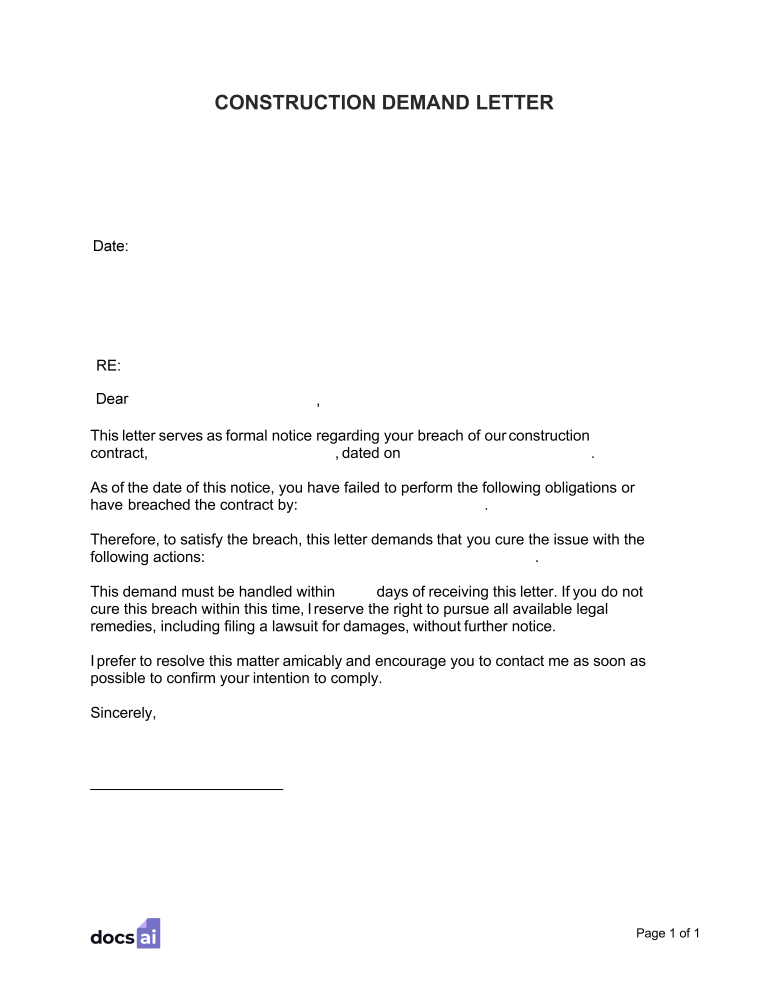
3. Develop Then Send the Demand Letter
Write a demand letter summarizing the issue (e.g., change orders, missed payments) and seeking a remedy should the offending party continue to be uncooperative.
- Begin with a professional header (e.g., company banner, logo).
- Point out delinquent payments or explicitly state the offending action.
- Discuss the potential legal remedies and options that could resolve the issue.
- State when the desired remedy is expected by stating a deadline or cure period.
- Present a resolution opportunity and close professionally and amicably.
4. Give Ample Time To Respond
5. Enforce Your Rights If They Don’t Comply
Explore additional options that rectify the issue in cases where the client ignores the letter, refuses to take action, or becomes hostile:
- A third-party neutral arbitrator can be obtained (e.g., Better Business Bureau).
- File a grievance with a body that provides oversight, such as a licensing board.
- A mechanic’s lien can be placed on the property through the courts.
- A lawsuit can be initiated and pursued (e.g., civil suits, quantum meruit).
Sample
-
Yes, issue a demand if negotiations fail to remedy a contractual breach (e.g., nonpayment, failure to meet timelines, etc.).
-
Yes, concrete proof (e.g., contract, invoice, photo evidence) of the violation or nonpayment must be attached.
-
Yes, present the facts accurately, do not make false legal threats, and use direct and professional language.
-
Yes, unless the state jurisdiction states otherwise, this can be emailed; however, this often lacks the security and reliability provided by certified mail.
-
Yes, 7 to 14 days from the letter date is the traditional response time.